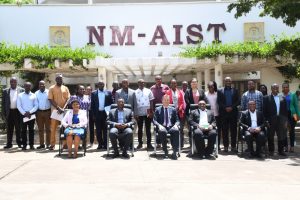
The Ambassador of Switzerland to Tanzania, H.E. Didier Chassot commended the Nelson Mandela African Institution of Science and Technology (NM-AIST) for its dedication and efforts to becoming a world-class institution for Science, Engineering, Technology and Innovation, said that during his official visit to NM –AIST on 3rd December 2021.
The visit aimed to observe the institution preparedness to host two projects that will be implemented jointly NM-AIST and the Swiss Federal Institute of Technology Lausanne (EPFL) from Switzerland and Mohammed VI Polytechnic University (UM6P) from Morocco, namely the Centre of Competence in Digital Education (C-CODE) and Exploiting the Potential of underutilized African plants and agricultural wastes in biofuels production projects.
H.E. Didier, in his speech, congratulated the institution for hosting two projects from Excellence in Africa initiative, through a highly competitive call, were selected by EPFL to host a C-CODE and biofuel in Tanzania.
He said that “Switzerland government has long been a key supporter to the efforts in that field, and we aim to strengthen the capacities of the health sector further; enabling civic activities around health governance, and facilitating access to health services.”
The Ambassador was taken to a virtual campus tour by the NM-AIST Vice-Chancellor Prof. Emmanuel Luoga and later briefed on the history and inception of the institution. During his presentation, Prof. Luoga informed the Ambassador that the institution is working toward solving society problems by providing innovative solutions to challenges related to climate change, health, water and sanitation, and energy especially in this period of the COVID-19 pandemic.
On the other hand, during his presentation, the Deputy Vice-Chancellor for Academic Research and Innovation, and the Principal Investigator for the C-Code project, Prof. Anthony Mshandete, emphasized the importance of online education to African countries. He said:
“We thank EPFL and UM6P in the framework of the “Excellence in Africa initiative” that supports the establishment of C-CODE, and funding for a research projects to exploiting the potential of underutilized African plants and agricultural wastes in biofuels production”. The C-code project will be hosted by the Centre for Water Infrastructure and Sustainable Energy Futures (WISE-Futures) at NM-AIST
Concurrently, the Principal Investigator for the biofuels production project, Dr Thomas Kivevele, said the project is worth seven hundred dollars for five years. The project will help communities earn income and add value to plant residues, including coffee residues, which were previously considered waste.
The visit was part of the Switzerland mission in Tanzania to celebrate 40 years of development cooperation with Tanzania